
Saudi Arabia to launch 16th satellite into space
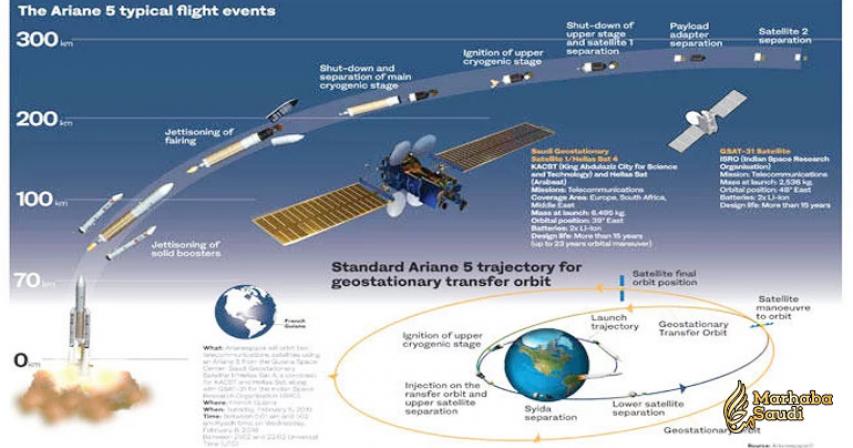
The Kingdom will launch its sixteenth satellite into space on Tuesday: The Saudi Geostationary Satellite 1 (SGS-1).
It will give broadcast communications capacities, more grounded web network, TV and secure interchanges in the Middle East, North Africa and Europe.
Created by a group from King Abdul Aziz City for Science and Technology (KACST), it will be propelled in French Guiana by Arianespace, which gives dispatch administrations to a wide range of satellites.
KACST, an administration foundation that backings and improves connected research, worked together with Lockheed Martin to produce the SGS-1.
The foundation has so far propelled 15 satellites into the low Earth circle, said the SGS-1 program executive from KACST, Dr. Badr Al-Suwaidan.
KACST has worked together with China in the Chang'e 4 mission to investigate the furthest side of the moon; gave propelled administrations to remote-detecting frameworks; and partook in the dispatch of a propelled framework for sea observing and following satellite information, which incorporates every day inclusion of 30,000 vessels around the world.
Lockheed Martin is a worldwide security and aviation organization that is occupied with the exploration, plan, improvement, produce, combination and sustainment of trend setting innovation frameworks and administrations. Its association with Saudi Arabia started in 1965.
The #SGS-1 provides secure satellite communication on the Ka-band for the government of #Saudi Arabia @BadrDrSpace @kacst @Arianespace @LockheedMartin @ISRO #HellasSat #Ariane5 #Arianespace #VA247 https://t.co/OtG3hA1vv3 pic.twitter.com/EsBGp1J56h
— Arab News (@arabnews) February 5, 2019
"We will probably convey trend setting innovation and security answers for the Saudi government and business division in help of Vision 2030," said Lockheed Martin CEO Joseph Rank.
The SGS-1 was fabricated, tried and worked with the investment of Saudi designers and researchers.
The assention of the dispatch benefit between Arianespace, Arabsat and KACST was declared in 2015.

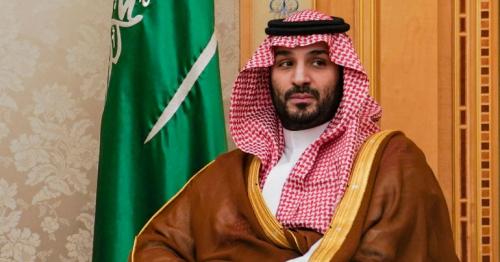
In 2018, Saudi Crown Prince Mohammed receptacle Salman regulated assembling stages amid his visit to Lockheed Martin's San Francisco home office.
Amid this visit, the crown sovereign marked the last piece that should have been set on the SGS-1 preceding its dispatch, with the words: "Over the most elevated mists."
The satellite will be propelled by the Guiana Space Center, which is situated in French Guiana since it is close to the equator; it has a little populace; and it isn't inclined to catastrophic events. The vehicle that will dispatch the satellite is the European Ariane 5.
The SGS-1 "gives secure satellite correspondence on the Ka-band for the administration of Saudi Arabia. It gives 35 gigabits for each second," said Al-Suwaidan, hailing "another period."
The Ka-band takes into account higher transmission capacity correspondence, supporting more prominent recurrence reuse in geologically confined spots.
Spot pillars are satellite flags that are moved in power with the goal that they cover a restricted geographic region.
Spot bars are utilized with the goal that just Earth-based stations in a specific territory can appropriately get the satellite flag.
"The program incorporates innovation exchange for in excess of 15 engineers prepared and affirmed by the producer Lockheed Martin," said Al-Suwaidan.
There will be more "space accomplishments under the new Saudi space specialists," and under "the initiative of the primary Arab space traveler, Prince Sultan receptacle Salman," Al-Suwaidan included.
The SGS-1 was amassed at Lockheed Martin's offices in Denver, Colorado and Sunnyvale, California. In Sunnyvale, it experienced basic ecological testing.
"We had a pleasing and smooth dispatch battle because of the group from KACST, Arabsat and Lockheed Martin. We're prepared for the dispatch," said Al-Suwaidan. "We're thankful for the coordinated effort and administration given by Arianespace."
The SGS-1 will be the 46th Lockheed Martin satellite to be propelled by Arianespace. The launcher's principle stage will sprinkle down in the Gulf of Guinea.
Thierry Fahem, the SGS-1 program chief from Arianespace, wished the satellite "a long life."

Comments