
Prophet's Mosque, Madinah : Great status and vast expansions in the Saudi era
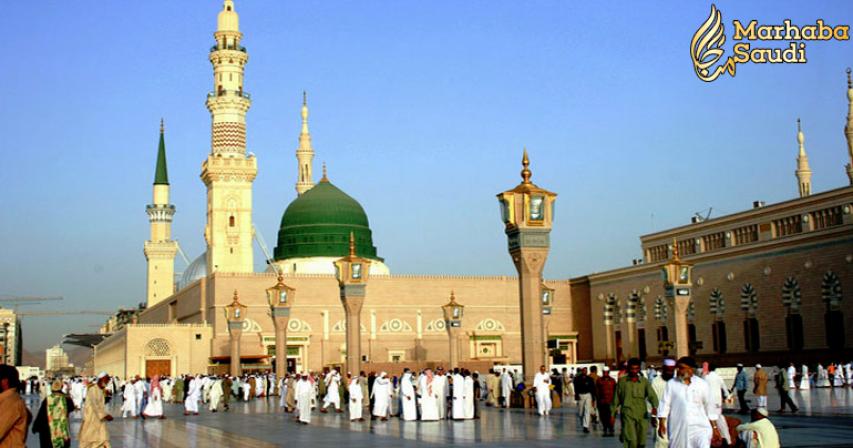
The Prophet's Mosque in Madinah is a place Muslims from around the globe visit while performing Hajj and Umrah, or basically to ask (playing out the salat) and visit Prophet Muhammad's tomb.
One of the world's biggest mosques, the Prophet's Mosque experienced a few developments all through its history, beginning with the times of the caliphs, trailed by the Umayyads, the Abbasids, the Ottomans, and, at long last, the Saudi time, amid which it experienced the biggest extension in its history and was the primary spot in the Arabian Peninsula to be lit by electric lights in 1909 (1327 AH).
The Prophet's Mosque, otherwise called Al-Masjid Al-Nabawi, was the second mosque worked by Prophet Muhammad (peace arrive) in the principal year of Hijrah (the Prophet's movement with his supporters from Makkah to Madinah, which was called Yathrib at the time).
The arrive on which the mosque was manufactured had a place with two vagrants, Sahl and Suhail, and was utilized as a place for drying dates. The Prophet arranged the mosque's structure to possess a 50 by 49 meter tract of land and constructed it confronting Jerusalem, the Muslim's Qibla at the time. He burrowed the establishment and utilized palm leaves for the rooftop and trunks of palm trees as columns.The Prophet likewise fabricated his mosque with three entryways, one of which was in the back and was called "Atikah" or the "Entryway of Mercy," while the other was the "Entryway of Gabriel" and was the Prophet's favored passageway.
In the back of the mosque, there was a shady zone for protecting poor people and outsiders known as "Al-Saffa."
Prophet Muhammad did not fabricate a rooftop for the whole mosque, so when it drizzled, water would trickle on admirers. The admirers requested that the Prophet bolster the rooftop with mud, yet he denied and stated: "No, an arish like that of Moses" — a trellis rooftop like that of Moses.
In its initial days, the mosque's floor was not shrouded with anything until in 3 AH (624 AD), when it was secured with rocks.
At the point when the Qibla was changed to confront the Kaaba rather than Jerusalem, Al-Saffa, which was in the southern piece of the mosque, was moved toward the northern part. The indirect access was shut, and another entryway was opened in the north.
The Prophet's Mosque experienced its first development in the times of Caliph Umar ibn Al-Khattab in 17 AH (638 AD). Caliph Abu Bakr Al-Siddiq did not chip away at growing the mosque since he was occupied with the Ridda Wars, otherwise called the Wars of Apostasy.
The mosque turned out to be exceptionally jammed with admirers in the rule of Caliph Umar, so he purchased the encompassing houses and included them in the mosque to extend it by 20 cubits from the west, 10 cubits from the south (the Qibla part), and 30 cubits from the north. No extension, in any case, occurred in the eastern piece of the mosque as the rooms of the prophet's spouses were situated there.
After that extension, the mosque's length ended up 140 cubits from north to south and its width 120 cubits from east to west. It was worked in a similar shape picked by Prophet Muhammad; the dividers were worked of blocks, palm-tree trunks were utilized as segments, the 11-cubit-high rooftop was made of palm leaves, and the ground surface was made of garnet corn meal. Caliph Umar likewise included a 2-cubit-high frock to the mosque.
The extension that occurred in the times of Caliph Umar was evaluated at 1,100 square meters. It likewise gave the mosque six entryways: Two in the east, two in the west, and two in the north.
Amid the reign of Caliph Othman in 29 AH (650 AD), the mosque turned out to be too little for the extensive number of admirers, so he counseled the Prophet's colleagues on extending it and they discovered it a smart thought.
Caliph Othman had the mosque's dividers worked of cut stones and mortar, its segments of engraved stones and iron bars introduced in lead, and its top of teak wood. The six entryways were left as they were following the extension done by Caliph Umar.
The Prophet's Mosque stayed as it was after the extension did by Caliph Othman and until the reign of Al-Walid receptacle Abdul-Malik in 88 AH (707 AD). Al-Walid kept in touch with the leader of Madinah, Omar receptacle Abdul Aziz (86-93 AH/705-712 AD), requesting him to purchase the houses around the Prophet's Mosque so as to grow it. He additionally guided him to incorporate the rooms of the Prophet's spouses in the extension.
Following the orders of Al-Walid, Omar container Abdul Aziz extended the Prophet's Mosque and influenced the Prophet's tomb to some portion of it. Subsequently, Al-Walid's extension was from three sides — east, north, and west — and the southern divider's length moved toward becoming 84 meters, the northern divider 68, and the western one 100. The entire development was assessed at 2,369 square meters.
The extension amid the rule of Al-Walid canister Abdul-Malik included building an empty mihrab and minarets without precedent for the Prophet's Mosque. A sum of four minarets were assembled, one in each corner, and additionally patios on the mosque's rooftop.
No extension was done in the Prophet's Mosque after Al-Walid's development, however there were a few repairs and remodels.
...[ Continue to next page ] / Source: arabnews


Comments