Mandela’s former aides reveal pivotal role KSA played in his fight for freedom
A century ago today, a boy was born who would grow up to change the world.
There was nothing auspicious about his beginnings, although there was perhaps a clue in the name he was given: Rolihlahla, which means “troublemaker” in his native Xhosa language.
And make trouble he most certainly did, though it was the right kind of trouble and at great cost to himself.
On May 10, 1994, Nelson Rolihlahla Mandela (he was given his English first name by a teacher) was sworn in as president of South Africa. He was the country’s first black head of state and the first to be elected in a fully representative democratic election. The hateful age of apartheid was finally over.
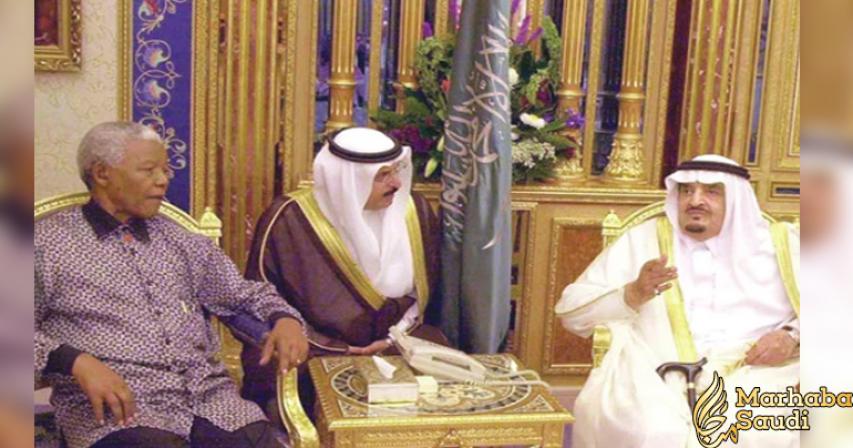
Nineteen days later, the South African government signed an agreement establishing diplomatic relations with Saudi Arabia and in October 1994 President Mandela visited the Kingdom.
It was one of his first trips abroad and the first of many as president to the Gulf, highlighting the importance he accorded to the region. A year after his election, in April 1995, Mandela went to Kuwait, Oman, Qatar, the UAE and Bahrain. The following year, he visited Egypt, Libya and Morocco.
In early 1962, Mandela had secretly left South Africa to travel around the continent building support for the armed struggle against apartheid. He received military training in Morocco and Ethiopia. As president, maintaining good relations with the Arab world was of prime importance, even if it made him unpopular with the West, whose attitude toward him had been ambivalent at best.
In response to Western concerns over his invitations to Muammar Qaddafi and Fidel Castro, he told Reuters in 1996: “Your (the West’s) enemies are not our enemies. We will not be persuaded to break with our friends because now the great powers in the West want to be our friends. We can be friendly to them without parting with our friends who were with us when we were all alone.”
After his release from prison in 1990, Mandela embarked on a tour of countries that had supported the African National Congress (ANC) during the years of struggle. Riyadh was among the cities he visited and it was there the future leader forged some of his strongest alliances.
Tom Lodge, a former professor of political studies at the University of Witwatersrand and author of “Mandela: A Critical Life,” said: “Almost certainly there was more to the visits than to say ‘thank you.’ Mandela continued to raise funds for the ANC, though probably not on a state visit. South Africa in 1994 was short of capital and up to the 1990s it was buying oil in violation of sanctions, very expensively.
“At the time of Mandela’s presidency, he was ready to defend arms sales to various Middle Eastern countries as a reciprocal obligation for anti-apartheid support. He had a particular affection for the Moroccans because of the hospitality they showed him in 1962.”
Mandela was also keen to bring South Africa back into the international fold.
“The drive to strengthen and deepen relations with the Middle East was part of a more general thrust to build links with the international community, which had mostly cut ties with apartheid South Africa,” said Tony Trew, a former communications officer in the Office of the President, who contributed to a book on the Mandela presidency.
“Among other things, it meant shifting the balance of relations and dependencies to some extent from traditional partners of South Africa to others, in particular in Africa, the Middle East and Asia.”
Journalist Khaled Almaeena met Mandela several times, both in Riyadh and the South African capital Pretoria. Years of forced labor breaking rocks in the blinding sun on Robben Island had taken a toll on Mandela’s eyesight, and Almaeena recalls the president having his eyes checked at a Riyadh hospital.
At their first meeting, Almaeena’s knowledge of South African history, geography and sports so impressed Mandela that he jokingly asked: “Are you sure you are not an Afrikaner?”
Later, when Almaeena visited Pretoria with a group of Saudi business figures, he was touched by the warmth of Mandela’s greeting.
...[ Continue to next page ] / Source: arabnews
Comments